Last updated: June 2026 · 12 min read · Corporate Stays Editorial
Key Takeaways
Short term furnished rental cost savings typically range from 20–40% compared to business hotels on stays of 30–90+ days. These savings come from lower nightly rates, all-inclusive billing, and fewer hotel-style add-ons.
- Furnished corporate rentals often become more cost-effective than hotels around the 10–14 night mark.
- Cost savings compound on extended assignment stays because rent, utilities, high speed internet, parking, and laundry are usually bundled.
- Many regions waive hospitality taxes for stays over 30 days, while hotels usually remain taxable.
- Corporate Stays operates fully furnished, move in ready apartments with flexible 30–365 day leases for business travelers and corporate relocation housing.
- This guide gives relocation managers and HR leaders concrete cost comparisons, a policy-ready framework, and a provider checklist.

The Hidden Cost of Corporate Hotels
Headline hotel rates in major Canadian cities such as toronto, Montreal, and Vancouver rarely show the full total cost of stay. A hotel room quoted at CAD $260 per night can become materially more expensive once taxes, tourism fees, parking, premium internet, restaurant meals, laundry, and meeting-space charges flow into the T&E budget.
For example, a 30-night stay in a 4-star business hotel in downtown Toronto in 2026 at CAD $260 per night starts at CAD $7,800 before extras. Ontario’s HST is 13%, and hotel stays can also include tourism or destination-style fees. By contrast, a comparable furnished apartment often includes rent, utilities, high speed internet, appliances, furniture, and in-unit laundry in one monthly invoice, which makes it more affordable than the hotel once those bundled inclusions are counted.
This difference matters because hotel charges scale daily. Parking may add CAD $25–$40 per night. Premium Wi-Fi upgrades can add CAD $10–$25 per night. Laundry or valet can cost CAD $15–$30 per item. Meals become one of the largest other expenses when employees cannot prepare their own meals.
Furnished apartments reduce these leakages. Many furnished rentals include free Wi-Fi in the base price. Most furnished rentals include utilities and internet in one bill, simplifying budgeting. Furnished rentals include utilities, simplifying budgeting, and rentals rarely charge mandatory daily amenity fees.
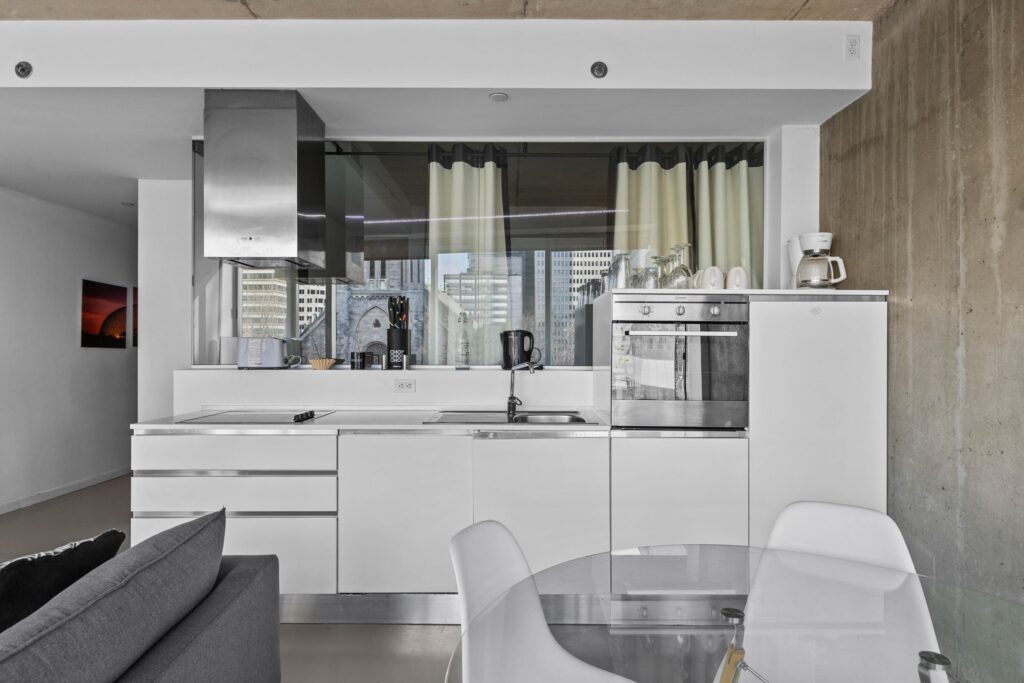
Furnished apartments are also move-in ready with essential amenities included. They eliminate costs for furniture purchases, save on moving costs and logistics, and simplify an easy move in with no heavy lifting. For temporary residents, that convenience helps companies save money and makes a furnished unit a more controlled financial choice than hotels and many unfurnished options.
30-Day Cost Comparison: Hotel vs. Furnished Rental
The table below models a realistic 30-day corporate stay in Toronto for one employee in 2026. It compares a business-class hotel with a one-bedroom furnished rental at a similar location and quality level.
Cost item | 4-star business hotel | Furnished rental |
|---|---|---|
Base lodging | CAD $260 × 30 = CAD $7,800 | CAD $185 × 30 = CAD $5,550 |
Lodging taxes / hospitality fees | CAD $1,350–$1,450 | Often CAD $0 on 30+ day residential lease |
Destination / amenity fees | CAD $600–$900 | CAD $0–$150 |
Parking | CAD $750–$1,200 | CAD $0–$450 |
Premium internet | CAD $300–$600 | Usually included |
Laundry | CAD $300–$600 | Included through in-suite laundry |
Meals above grocery cost | CAD $1,200–$1,800 | CAD $400–$700 |
Cleaning | Usually built into nightly rate | Cleaning fees are usually charged per stay, not per night |
Total Cost of Stay | CAD $10,300–$11,200 | CAD $6,300–$7,000 |
The result is 30–40% short term furnished rental cost savings on a single 30-night assignment. Furnished rentals can be half the cost of hotels in high-demand periods, especially when parking, meals, and laundry are included in the comparison.
One caution: high security deposits and cleaning fees can inflate total costs if procurement does not review the rental agreement. Many short-term rental platforms add service fees of 10% to 20%, while booking directly with property managers can save 10% to 15% by avoiding platform fees.
Why Short-Term Furnished Rental Cost Savings Compound Over Time
Nightly savings may look modest at first. The financial impact becomes clearer on 45-, 60-, and 90-day assignments where long term leases are impractical and hotels remain the default.
The savings curve is simple. Hotels charge by the night, and many expenses continue every day. Furnished corporate rentals usually reduce the effective daily rate as the stay duration increases. Properties frequently offer considerable discounts for longer stays of 28 days or more, and monthly bookings can qualify for price cuts of 30% or more.
Short-term leases typically last from one to twelve months. Furnished rentals are ideal for temporary stays of one to six months because they bridge the gap between nightly hotels and 12-month long term leases. Flexible lease terms range from weekly to monthly rentals, although corporate housing programs usually standardize around 30-, 60-, 90-, and 365-day terms.
Short-term leases usually command higher rent than long-term leases, but the corporate question is not whether the monthly rent is higher than a traditional apartment. The question is whether the total cost is lower than a hotel, once utilities, furniture, laundry, internet, services, and other expenses are included. In most extended stay vs hotel cost models, the furnished option produces lower rent on an effective daily basis.
Seasonality also matters. Booking during off-peak seasons generally results in lower base rates. Hosts frequently offer discounts for week-long stays of 10% to 15%, but the larger savings typically appear once a company moves from weekly stays to monthly housing.
The Savings Curve by Assignment Length
The table uses the same Toronto business-travel assumptions: a 4-star hotel versus a premium furnished apartment, including typical taxes and major incidentals.
Length of stay | Hotel total cost | Furnished rental total cost | Approx. savings |
|---|---|---|---|
7 nights | CAD $2,100–$2,250 | CAD $1,700–$1,900 | 10–20% |
14 nights | CAD $4,000–$4,300 | CAD $2,900–$3,300 | 20–25% |
30 nights | CAD $10,300–$11,200 | CAD $6,300–$7,000 | 30–40% |
60 nights | CAD $20,000–$21,500 | CAD $11,500–$13,000 | 35–40% |
90 nights | CAD $29,000–$31,000 | CAD $16,000–$18,500 | 40%+ |
The crossover point usually appears around night 10–14 in major Canadian cities. Beyond 30 nights, furnished rentals are often more cost-effective than hotels because utility costs, internet, and laundry do not restart every day.
Multi-bedroom rentals cost less than booking multiple hotel rooms. A two-bedroom furnished apartment can house two employees on the same project for less than two separate rooms, while preserving privacy and more space. That makes shared corporate furnished apartments a smart choice when policy permits room-sharing by separate bedroom rather than shared sleeping space.
Beyond the Budget: The Productivity Dividend
The productivity dividend is the value gained when employees live in a space that supports sleep, private work, and a stable routine during an extended assignment. It is not always visible on an invoice, but it directly affects daily life, performance, and assignment completion.
A typical hotel room may offer limited space for work, meals, and rest. Corporate furnished apartments often provide more space, a separate bedroom, a fully equipped kitchen, in-suite laundry, and a dedicated work area. Furnished apartments provide a home-like environment with privacy, which matters when the temporary stay lasts weeks rather than days.
Cooking meals at home cuts down restaurant expenses entirely when employees choose to self-cater. A fully equipped kitchen lets business travelers control their schedule, diet, and budget. In-unit washers eliminate costly hotel laundry charges and reduce time spent coordinating extra services.
Consider a 90-day project in Toronto involving a senior manager waiting for a permanent new place. In a hotel, the employee would likely submit recurring meal, laundry, and parking claims. In a furnished suite, the company can pay one predictable rental invoice, while the employee maintains a normal routine: groceries, private calls, laundry, work, sleep.
Duty of care also improves. A fully equipped, secure apartment in the right city location gives HR clearer visibility into housing standards than ad-hoc bookings by many renters across short term rental websites. Reliable access, high speed internet, professional maintenance, and secure buildings reduce operational concerns for relocation managers.

What to Look for in a Corporate Furnished Rental Provider
Not all furnished rentals are designed for corporate mobility. A private landlord renting a house or apartment may serve individual tenants well, but corporate relocation housing requires consistent standards, predictable billing, and responsive support.
HR and finance should evaluate providers against five criteria: verified inventory, flexible lease terms, guest support, billing, and footprint. Renting furnished apartments through a managed provider gives companies more control than relying on scattered listings with inconsistent amenities, policies, and services.
1. Verified Inventory
A serious provider should control or closely manage its inventory rather than relying only on ad-hoc third-party listings. For large programs, 4,500+ managed rental units signal stronger availability, quality control, and operational depth.
Unit standards should include furnished suites with consistent furniture packages, professional cleaning, safety checks, regular maintenance, accurate photos, and detailed amenity lists. Each unit should clearly show whether it includes parking, laundry, utilities, internet, appliances, workspace, and community amenities.
Relocation managers should also ask about service-level agreements. Define check-in standards, issue-resolution timelines, emergency access procedures, and after-hours support. These details protect the employee experience and the employer’s reputation.
2. Flexible Lease Terms
Corporate programs need lease flexibility. A provider should support 30-day minimums that can extend to 60, 90, six months, or 365 days without punitive jumps or complex re-contracting.
Rigid long term leases lock companies into 12-month obligations and increase the risk of paying for empty apartments when assignments change. Furnished rentals often offer month-to-month lease options, which can reduce financial exposure when a project ends early or a relocation date shifts.
Policies should cover extensions, early departure, transfers across properties, notice periods, and security deposit handling. Finance teams need these rules before they approve a rental, not after an employee has moved in.
3. Concierge & Guest Support
Relocation managers should not become the help desk for lost keys, access issues, maintenance requests, or local questions. Corporate housing providers should offer 24/7 or extended-hours guest support, multilingual assistance, and clear escalation paths.
Support should also cover practical needs: transportation, grocery access, health services, building procedures, and local shopping. This level of support reduces HR workload and improves satisfaction among business travelers who need to stay longer in unfamiliar markets.
Better support increases the likelihood that an extended assignment finishes on time. It also reduces policy exceptions, emergency hotel nights, and avoidable complaints.
4. All-Inclusive Billing
All-inclusive billing simplifies T&E budget management by bundling rent, utilities, high speed internet, basic furnishings, and often parking into one monthly invoice. It also reduces expense report volume and improves forecasting for corporate housing cost comparison reviews.
A mature invoice should show one line per unit per month, dates of stay, employee name or cost centre, tax treatment, and approved extras. That structure helps accounting teams pay accurately and helps legal or compliance teams review records.
Ask whether the provider can align billing cycles with corporate accounting periods, issue consolidated statements, and standardize rate cards by city. Also confirm whether tenant insurance is included, required separately, or handled through a corporate guarantee.
5. Global Footprint
While this article focuses largely on Canada, many HR and corporate mobility teams manage assignments across multiple countries in the Americas. A provider with coverage across key business hubs in Canada and Latin America can standardize quality, pricing expectations, and duty of care processes.
A single partner serving major Canadian markets and major Latin American capitals simplifies vendor onboarding, compliance review, and reporting. It also helps companies apply one housing policy instead of piecemeal local arrangements.
For procurement, footprint creates leverage. For HR, it creates consistency. For employees, it creates a more predictable lifestyle during a demanding move.
Frequently Asked Questions
These answers address common concerns from HR, relocation managers, and finance teams about savings, assignment length, suitability, deposits, and billing workflows.
How much can companies realistically save with short-term furnished rentals?
Companies can realistically save 20–40% against comparable hotels on 30–90 day stays, with a conservative planning assumption of 15–20% in most major cities. Savings can increase when teams use multi-bedroom apartments, when employees prepare their own meals, or when a rental avoids hotel taxes and daily amenity charges.
At what assignment length do furnished rentals beat hotels on cost?
Break-even often occurs between 10 and 14 nights in major Canadian cities. Furnished apartments become clearly more cost-effective beyond 30 nights because many regions waive hospitality taxes for stays over 30 days and because monthly pricing reduces the effective nightly cost.
Are furnished rentals suitable for executive and senior leadership travel?
Yes. High-spec furnished apartments with premium finishes, central locations, housekeeping options, parking, privacy, and dedicated workspace are suitable for executives on multi-week projects. Relocation managers should specify requirements in advance so the selected unit matches executive expectations.
How does billing work for corporate clients using furnished rentals?
Corporate clients typically receive centralized monthly invoicing, itemized by property, employee, stay dates, and approved charges. Some providers align billing cycles with accounting periods and issue consolidated statements across departments or locations.
What role does a security deposit play in corporate bookings?
Providers may request a refundable security deposit or accept a corporate guarantee under a master service agreement. Deposit handling, inspection timelines, damage charges, and refund procedures should be documented in the housing contract so finance and legal teams can approve the arrangement confidently.
The Bottom Line
Short-term furnished rentals consistently outperform hotels on direct costs and employee productivity for stays of 30–365 days. They give companies a practical middle ground between nightly hotels and long term leases, with clearer control over monthly expenses, quality, and duty of care.
Use the cost tables and provider checklist in this article as the backbone of an internal housing guideline. Define when hotels make sense, when furnished corporate rentals become mandatory, and how exceptions get approved.
Corporate Stays manages 4,500+ premium, fully furnished, move in ready apartments across Canada and Latin America, built for the exact assignments your policy will govern. To talk to a corporate housing specialist, contact [email protected] or +1 (800) 213-6030.