Last updated: June 2026 · 8 min read · Corporate Stays Editorial
When comparing corporate housing vs hotels in Canada, the numbers are stark: a 60-day hotel stay in Toronto — at the city’s 2026 average daily rate of approximately $260 — generates a gross accommodation bill of over $15,600.[1][2] A comparable fully furnished corporate apartment costs roughly $5,000 per month, all-in.[3][4] For a two-month assignment, that gap exceeds $5,600 per employee, before a single meal, parking charge, or laundry fee is counted.
This article breaks down the full cost of corporate housing versus extended stay hotels across four major Canadian markets — Toronto, Montreal, Vancouver, and Calgary — for 2026. It is written for travel managers, HR business partners, and project procurement managers who need accurate, defensible figures to justify accommodation decisions at the decision stage.

The true cost of extended hotel stays for business
When procurement teams evaluate hotel costs, they typically start with the nightly rack rate. That number is only the beginning of actual spend.
Based on average daily rates reported by STR Global and tracked through early 2026 by Avison Young, mid-market business hotels in Canada’s four largest cities currently average:
- Toronto: approximately $260/night [1]
- Montreal: approximately $234/night [1]
- Vancouver: approximately $232/night (March 2026 average) [2]
- Calgary: approximately $188/night [1]
Source: Avison Young / STR Global data via Daily Hive, March 2026; Business in Vancouver / Castanet, April 2026.
At these rates, a 30-day Toronto hotel stay costs approximately $7,800 in room fees alone. A 60-day assignment crosses $15,600. A team of three on a 90-day project generates over $70,000 in room costs — before incidentals.
Extended hotel stays consistently generate ancillary charges that initial budget models rarely capture:
- Parking: $25–$50 per day at most downtown business hotels in Toronto and Vancouver, adding $750–$1,500 to a 30-day bill.
- Meals: Without kitchen access, employees rely on restaurants and delivery. Industry estimates place daily meal spend at $45–$65 per person — adding $1,350–$1,950 per month per employee.[8]
- Laundry: Hotel laundry and dry cleaning averages $3–$8 per item. On a 60-day assignment, this routinely adds $200–$400 to the total.
- Wi-Fi: Many business-class hotels charge $15–$25 per day for premium-speed internet, even as remote work demands have raised bandwidth requirements.
A fully loaded 30-day extended hotel stay in Toronto — room, parking, meals, laundry, and connectivity — conservatively reaches $11,000 to $13,500 per employee.
What corporate housing actually costs per month
Corporate housing operates on a fundamentally different pricing model: a single monthly fee that bundles accommodation, utilities, high-speed internet, in-unit laundry, and a fully equipped kitchen. The variable cost stack of hotel stays is replaced by one predictable line item.
Based on current market data for fully furnished, corporate-grade one-bedroom apartments across Canada’s major business centres in 2026:
- Toronto: $3,800–$5,500/month (furnished, utilities included) [3][5]
- Vancouver: $4,200–$5,800/month (furnished, utilities included) [4][5]
- Montreal: $2,800–$4,200/month (furnished, utilities included) [7]
- Calgary: $2,600–$3,800/month (furnished, utilities included) [6]
Sources: TenantPay Canada Rent Guide 2026; ReloPlanner Canada 2026; Go Far Global June 2026; Neobanc / Expatistan Calgary 2026; Vistoo Montreal January 2026. Corporate housing rates reflect full furnishing, concierge support, and managed-property services above standard unfurnished asking rents.
Included in a typical all-in monthly rate: furniture and household essentials, high-speed internet, utilities (electricity, heat, water), in-unit washer/dryer, and professional property management. Parking varies by building but is available through most corporate housing providers at significantly lower rates than hotel parking.
What is not included in standard corporate housing: daily housekeeping (available at extra cost), concierge-on-demand, and hotel amenities such as pools or 24-hour room service. For professionals on assignment, these trade-offs are rarely material — and the cost reduction is.
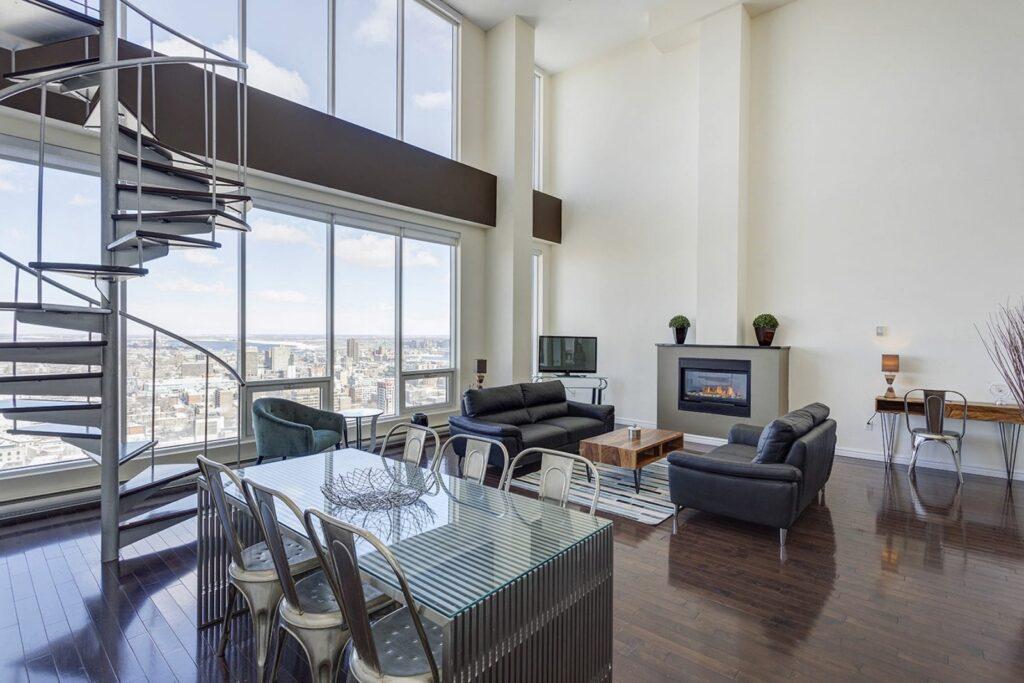
Side-by-side comparison — hotels vs. corporate housing
The table below compares the same cost categories across both accommodation types. Figures reflect Toronto-market benchmarks for a single professional on a 30-day assignment.
| Cost Category | Extended Stay Hotel | Corporate Housing |
| Nightly / monthly rate (Toronto) | ~$260/night → ~$7,800/month | ~$3,800–$5,500/month (all-in) |
| Parking | $25–$50/day extra | Often included or discounted |
| Kitchen access | None or kitchenette only | Full kitchen, fully stocked |
| Laundry | $3–$8/item, hotel service | In-unit washer/dryer included |
| Wi-Fi | Included or $15–$25/day premium | Included in monthly rate |
| Dedicated workspace | Desk beside bed, shared environment | Separate living/work areas |
| Minimum stay | 1 night | Typically 30 days |
| Invoice type | Per-night itemised billing | Single consolidated monthly invoice |
| Est. meal spend | $45–$65/day dining out | Reduced — full kitchen available |
The crossover point — where corporate housing becomes unambiguously more cost-effective on a total-spend basis — consistently falls between day 14 and day 21 in Canadian markets.[9][10] This accounts for the minimum-stay requirement common to corporate housing (typically 30 days) and the compounding ancillary costs that accumulate in hotel environments. For assignments of 30 days or longer, corporate housing is, in most cases, materially cheaper — not just on a per-night headline rate, but on the total invoice.
Hidden costs most companies miss
Four cost categories that rarely appear in a hotel invoice — but reliably appear in total assignment spend.
1. Meal costs without a kitchen
An employee without kitchen access will spend $45–$65 per day on meals.[8] Over 30 days, that is $1,350–$1,950 per person in food spend alone — a category that disappears almost entirely when a full kitchen is available. On a 90-day project assignment for a team of five, the cumulative meal overspend versus corporate housing can exceed $25,000.
2. Productivity loss from inadequate workspace
A standard hotel room averages roughly 300 square feet. Corporate housing units typically range from 700 to 1,200 square feet, with separate sleeping, living, and work areas.[8] For employees managing demanding schedules over extended periods, the difference between a desk beside a bed and a dedicated workspace is measurable in output, focus, and cognitive fatigue. This is a recognised factor in global mobility programme design and is increasingly cited by HR business partners as a driver of assignment success rates.
3. Employee wellbeing and assignment attrition risk
Extended hotel stays — 30 days or more — carry documented risks to employee wellbeing: disrupted sleep, poor nutrition from limited food options, psychological fatigue from transient environments, and the absence of daily routine.[9] For project workers on multi-month rotations or international assignees, the risk of early assignment termination due to housing-related burnout is real. The cost of a failed relocation — recruitment, onboarding, and lost project continuity — is widely cited in global mobility literature as equivalent to 50%–200% of the affected employee’s annual salary.
4. Finance team overhead from fragmented billing
Hotel stays generate per-night invoices — sometimes across multiple properties if the employee moves or the property is unavailable. For a finance team managing accommodation for five employees over a 90-day project, that can mean hundreds of separate line items requiring reconciliation. Corporate housing consolidates accommodation into a single monthly invoice per employee, reducing AP overhead and improving budget forecasting.[10]
Real-world savings: what companies are switching to corporate housing
Scenario 1: Construction firm, project team deployment
Note: The following is a representative hypothetical scenario based on real market rates.
A national construction firm deploying a 10-person project team to Calgary for four months initially budgeted extended-stay hotels at an average rack rate of $150/night per room — a total accommodation projection of $180,000. Switching to corporate housing at an average all-in rate of $3,200/month per unit[6] reduced the accommodation spend to approximately $128,000 for the same period. The net saving was approximately $52,000 — roughly 29% of the original budget — before accounting for the reduction in meal per diems enabled by full kitchen access across all units.
Scenario 2: Pharmaceutical company, VP relocation
Note: The following is a representative hypothetical scenario based on real market rates.
A pharmaceutical company relocated a Vice President from Montreal to Toronto for an eight-month project assignment. Extended-stay hotel accommodation at approximately $260/night[1] would have totalled roughly $62,400 over the assignment period. Corporate housing in downtown Toronto at $5,000/month all-in[3][5] brought the total to $40,000 — a saving of $22,400. The consolidated single-invoice billing also eliminated what the company’s travel manager estimated as three hours of monthly AP reconciliation time per individual on extended assignment.
Frequently asked questions
Is corporate housing cheaper than a hotel for long stays?
What is included in a furnished apartment monthly rate?
A fully managed corporate housing rate typically includes furniture and all household essentials, high-speed internet, utilities (electricity, heat, water), in-unit laundry, and professional property management. Parking may also be included or available as a fixed add-on.[8]
At what point does corporate housing become more cost-effective than a hotel?
Can my company get a consolidated invoice for multiple furnished apartments?
Yes. Most corporate housing providers offer consolidated billing for companies managing multiple units across cities, simplifying accounts payable and improving budget visibility. This is a standard feature for corporate accounts managing team relocations or project-based deployments.[8]
What cities in Canada have the best corporate housing options?

Find corporate housing in your city
Corporate Stays provides fully managed, furnished apartments for business professionals across Toronto, Montreal, Vancouver, Calgary, and more than 20 additional Canadian cities. Whether your team needs one unit for a 30-day project or multiple units across several markets, a dedicated account manager handles inventory, billing, and support.
Explore available furnished apartments in Montreal, Toronto, and Vancouver — or get a quote for your next corporate stay.